
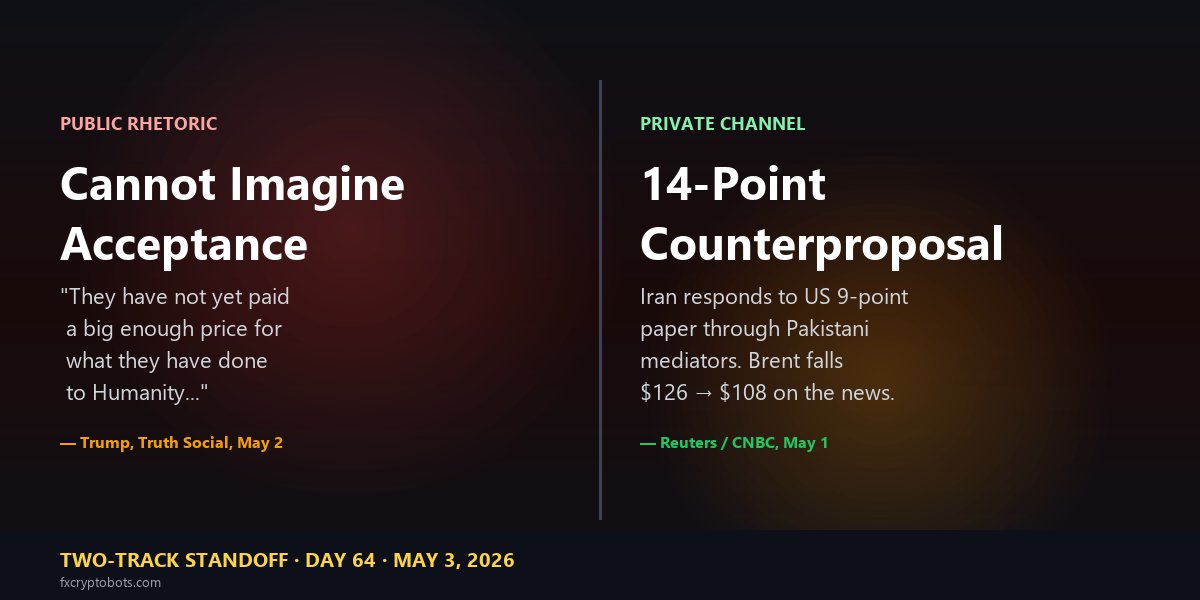
Inside 48 hours, three statements landed that fix the political envelope around any deal that gets done in the next 30 days. Two of them are public rhetoric designed for domestic consumption. The third is a back-channel proposal that nobody on either side has officially confirmed but everyone is acting on.
Read the asymmetry carefully: Trump’s post is rejection-by-mood (“cannot imagine”), not rejection of any specific term. Khamenei’s threat is conditional (“if the United States resumes attacks”) — it does not promise action against the existing blockade, only against renewed bombing. Pezeshkian is the only voice that names a concrete grievance (the blockade) and asks for a concrete reversal. That is what a negotiation that is still alive sounds like, dressed in the language of one that is over.
Wednesday we put Trajectory C (kinetic spark) at 38% as a new base case. The single-binary catalyst was the Saturday Hormuz announcement and whether it came with an incident. Three things happened over the weekend that move that probability mass back, but not all the way:
Hormuz transit dropped to 9 ships, an Iranian patrol intercepted one tanker, US Navy issued a verbal warning. No carrier-group contact, no IRGC swarm, no missile demonstration. The “practical and unprecedented” phrasing was reserved for the political theater — the actual kinetic envelope tightened by one notch, not five. That is the signature of a side that wants the threat priced but not consummated.
A 14-point document is a negotiation artifact, not a press-release performance. Iran does not write 14 numbered terms unless it expects most of them to be debated. The fact that it answered a 9-point US proposal with a 14-point counter means there are at least five additional Iranian asks the US has not yet engaged on — which is also five places where US concessions might land without breaking the public rhetoric script.
The Truth Social phrasing is not noise. It tells the market that any final agreement has to be packageable as a defeat for Tehran — not a compromise. That rules out symmetric concession structures (sanctions-for-enrichment, blockade-for-Hormuz-reopening) at the political level even when they are functionally what gets signed. Iran’s 14 points, if accepted in any meaningful form, will need a wrapper that lets Trump claim full victory. That wrapper is where the deal can break.
Net of the three: the Saturday non-event collapses the immediate kinetic premium — that is the Brent move. The active 14-point channel raises the probability of a mediated framework. The “47 years” rhetoric raises the probability of a negotiation collapse if Tehran will not provide a Trump-narrative-compatible exit. Two of the three lean toward de-escalation, one toward break risk.
Pakistan-channel proposals continue to narrow. The 14-point and 9-point documents converge on something like 7–9 ratifiable terms within 21 days. The package is structured as a phased deal: blockade relief in stage one, enrichment freeze (not dismantling) in stage two, frozen-asset release tranches keyed to verification milestones. Trump frames it publicly as Iran “capitulating” on enrichment to maintain the “47 years” narrative; Tehran frames it publicly as the US “ending its siege” to satisfy the deterrence claim. Brent fades to $92–98 as the war premium drains; gold range-trades $4,400–4,580 with the Warsh cap intact; BTC reclaims $80K on relief flows.
Trump’s “cannot imagine” framing turns out to be operational, not rhetorical. The 14-point counter is rejected publicly within 14 days. No new proposal lands. Iran does not break the ceasefire but tightens Hormuz transit progressively; the US does not lift the blockade but does not escalate it either. Both sides settle into a frozen status quo at a worse level than late April: blockade in place, transit constrained, no kinetic incident. This is the “Saturday closure without casualties” trajectory we flagged Wednesday, played for an additional 60–90 days.
The Saturday non-event collapses the immediate kinetic premium but the conditional Khamenei warning (“if attacks resume, long and painful strikes”) keeps the tail. Triggers are now narrower: a US strike on an Iranian asset in response to a tanker incident, an Iranian missile demonstration aimed at Omani waters, or a US carrier-group repositioning that Tehran reads as preparation. Same market shape as last week if it triggers — gold reclaims $4,800 in one session, Brent prints $115 inside 72 hours, BTC flushes 8–12% before recovering — but the path to triggering it is now narrower.
The Pakistan channel produces something neither side telegraphed — a face-saving framework that lets Trump claim full nuclear victory while leaving Iran with deferred enrichment rights and immediate blockade relief. The 14-point and 9-point documents converge on 5–6 ratifiable terms inside 14 days, not 21–30. Markets are blindsided to the upside on relief assets; gold takes a sharp negative gap, Brent prints $85, BTC gaps to $86K. This is the trajectory that gets ignored because nobody is positioned for it.
The most important market signal of the past 96 hours is the one that did not happen. A “long and painful strikes” warning from Khamenei’s office on a Friday night should have generated a $40–60 gap higher in gold on Sunday open. It did not. Gold traded heavy. The reason matters because it tells you what is actually binding on the gold tape right now.
EM central bank selling: Turkey, Argentina, Egypt all defending currencies into the dollar move; bullion is the fastest reserve to monetize. This is the dominant flow against the safe-haven bid.
Warsh hawkish cap: the FOMC 8–4 dissent vote on Apr 29 priced a hawkish hand-off to the new Chair; that cap is unchanged and any kinetic-driven bid runs into it at $4,800.
Conditional threat language: Khamenei’s warning was “if the US resumes attacks.” The market reads conditional threats with two levels of discount — first the trigger probability, then the response probability. Both are below 50%.
Tether supply: printed $150B+ for the first time during Q2 2026. That is a structural bid that does not care about Iran headlines.
Decoupling vs gold: on Trajectory A or D outcomes, BTC reclaims $80K–84K while gold fades. The setup is asymmetric in BTC’s favor for the May NFP and CPI window.
Risk: the only path BTC underperforms here is Trajectory C trigger — an actual kinetic event, where BTC initially flushes 8–12% before reclaiming.
The trade implication: the divergence between gold (which should be bid on Khamenei’s threat but is not) and Bitcoin (which is being bought on the de-escalation read of the 14-point counter) is the highest-conviction expression of the two-track market. If you want to play the de-escalation tape: long BTC vs short gold spread. If you want to play the negotiation-collapse tape: invert. The single-leg expressions are noisier than the spread.
| Asset | Mediated Framework (Trajectory A) | Negotiation Collapse (Trajectory B) | Kinetic Spark (Trajectory C) |
|---|---|---|---|
| Gold (XAUUSD) | Sell rallies $4,560–4,600; target $4,420 first, $4,340 on confirmation. Stop $4,640. | Range $4,500–4,720; trade the band; do not chase breaks until 2-day close. | Buy first 2% fade after gap; target $4,950 then $5,100; stop tight under $4,800. |
| Bitcoin (BTCUSD) | Long $76K–77K, target $84K then $88K; stop $73K. | Range $74K–82K; trade the band; correlation vs Nasdaq dominates. | Buy first flush to $68K–72K; target $84K+ in two weeks once DXY softens. |
| Brent Oil | Short $108, target $96 first, $90 on confirmation. Calendar spreads cleaner than outrights. | Range $98–112; structural premium on front; favor outright over calendar. | $115 inside three sessions; do not chase, wait for first 4% fade. Sub-six ships/day signals $125. |
| DXY | Soft on de-risking; EUR/USD long is the cleaner expression. | Range-bound; mildly bid on safe-haven Treasuries flow. | Initial spike on Treasury bid, fades within ten sessions as Fed reaction function reprices. |
| VIX | 14–18; sell premium on relief. | 18–22; calendar spreads bid relative to outrights. | 30–40 print on first kinetic headline; put spreads, not outrights. |
| Defense / shipping equities | Underperform; rotate into refiners, airlines, EM bond ETFs. | Range with insurance repricing bid; ZIM, Kongsberg, Lockheed quietly outperform. | Gap up 4–7%; stay positioned through volatility. |
Watch for a third paper from Tehran narrowing the 14 points to 9–11, or a US response that engages on specific Iranian asks rather than flat-rejecting. Either is a Trajectory A confirmation. Silence past Friday May 9 is the first Trajectory B tell.
The first major US data print since the FOMC 8–4 dissent. A hot NFP forces the new Chair into a hawkish hand-off speech; that retightens the gold cap and amplifies the de-escalation BTC bid. A cool NFP loosens the cap and gives gold a second wind into any Iran headline. Iran trade and macro trade compound here.
Headline disinflation continues but core sticky. The market has priced this; only a 2 sigma surprise materially moves the rate path. Inside the Iran context, a hot core CPI gives Trump rhetorical cover to walk away from the 14-point counter (“our economy is fine, theirs is collapsing”); a soft print quietly pressures him toward closing a deal that supports oil-price normalization.
The number that matters most. Eleven-plus daily average across the week is Trajectory A confirmation. Eight-or-below average is Trajectory C rebuilding. Anywhere in between is the grind range that defines Trajectory B.
What to watch this week: (1) Any third Pakistan-channel paper before Friday. (2) Trump’s next Truth Social on Iran — phrasing shift from “cannot imagine” to “reviewing seriously” is the Trajectory A tell; phrasing shift from “cannot imagine” to “rejected” is the Trajectory B tell. (3) Khamenei’s next public speech — whether he repeats the conditional “if attacks resume” framing or shifts to unconditional escalation language. (4) Hormuz transit daily counts. (5) Lloyd’s war-risk curve shape — flattening is Trajectory A; resteepening front is Trajectory C rebuilding.
The Saturday non-event was the most important data point of the past week. It told the market that Tehran will price the threat but not consummate it — for now. The 14-point counterproposal told the market that Iran is still negotiating, even while its supreme leader threatens long and painful strikes. Trump’s “cannot imagine” post told the market that any deal has to land inside a narrow rhetorical envelope to be politically signable. Three signals, three tracks, one window.
The two-track market favors spread expressions over single-leg bets. Long Bitcoin against short gold captures the de-escalation read. Short Brent calendar spreads capture the priced-out kinetic premium without exposing a directional view. Gold $4,500–4,800 is the trade range; Bitcoin $73K–84K is the trade range; Brent $96–112 is the trade range. The trajectory you play decides which boundary you fade and which you chase.
Watch the Pakistan channel paper count. Watch the Hormuz transit count. Watch Trump’s phrasing shift from “cannot imagine” to either “reviewing seriously” (A) or “rejected” (B). The market is voting with its feet that Track A wins; the rhetoric is voting with its mouth that Track B does. The next two weeks decide which vote counts.