
☰
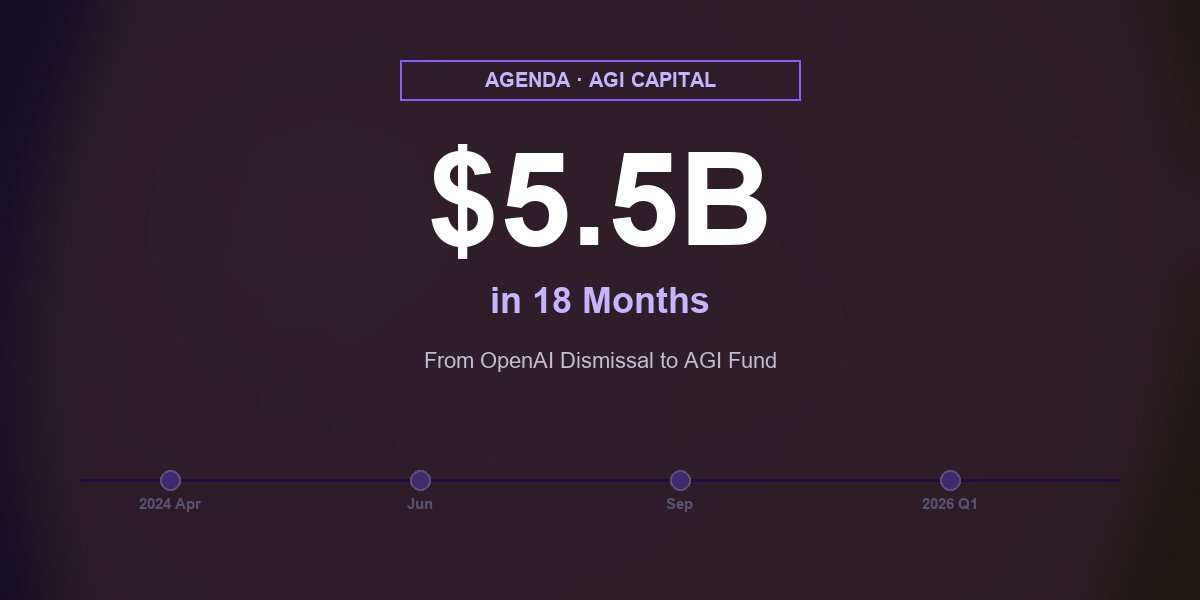
In April 2024 a 22-year-old researcher named Leopold Aschenbrenner was fired from OpenAI's Superalignment team. Two months later he published a 165-page essay titled Situational Awareness: The Decade Ahead, arguing that artificial general intelligence would arrive by 2027, that the United States had to outbuild China to control it, and that — as a side consequence — vast fortunes were available to whoever positioned correctly into the build-out. By September 2024 he had launched a hedge fund of the same name with seed checks from Patrick and John Collison (Stripe), Nat Friedman (now Meta AI), and Daniel Gross (now Meta Compute). Eighteen months later that fund's disclosed US equity exposure stands at $5.52 billion across 29 holdings, and the fund beat the S&P 500 by 47% in its first six months.
This piece is the full briefing: yesterday (what made him), today (what he owns), tomorrow (what 2026 and 2027 look like if he's right, and what they look like if he's wrong).
Aschenbrenner runs the most concentrated AI thesis in modern hedge fund history. He believes algorithms will commoditize and power, compute substrate, and unprecedented compute footprints will be the only durable moats. His top position is a fuel-cell company. His second is call options on a relatively obscure GPU cloud startup. His third is call options on a chipmaker Wall Street had already written off. He is short Nvidia on the way up. If he is right, his book compounds another 3–5x. If he is wrong, it draws down 60%+ in a single quarter — there is no middle scenario for a fund this concentrated.
Graduated from Columbia at 19. Took an early role at the FTX Future Fund as a research grant evaluator — the same vehicle that imploded with Sam Bankman-Fried. Joined OpenAI's Superalignment team, the unit Ilya Sutskever and Jan Leike led, focused on aligning future superintelligent systems.
OpenAI dismissed Aschenbrenner over what the company called an information leak. On the Dwarkesh Patel podcast two months later he characterized it as "a brainstorming document on preparedness, safety, and security measures" shared with three external researchers for feedback. The Superalignment team itself dissolved a month after his exit when Sutskever and Leike resigned.
The manifesto became the most-read AI strategy document of 2024 — read by venture capitalists, Pentagon analysts, hedge fund PMs, and several US senators. The core claim: GPT-style scaling, plus algorithmic efficiency gains, plus compute investment, will produce systems with effectively unlimited intellectual labor by 2027. The investment implication: whoever owns the compute and the power that runs it owns the new economy.
Seeded by Patrick and John Collison (Stripe), Nat Friedman, and Daniel Gross. The structure is a long-biased, concentrated equity hedge fund running 20–30 names with significant options overlay.
The thesis is summarized in one sentence: algorithms will be commoditized, but the electricity, the buildings, the GPUs, and the capital structure that runs them cannot be. Aschenbrenner therefore avoids the model labs entirely (no OpenAI, no Anthropic, no Google equity) and concentrates on the picks-and-shovels layer one step further removed than the consensus AI trade.
What this looks like in the 13F:
| Period | Disclosed equity exposure | Performance vs S&P 500 | Notes |
|---|---|---|---|
| Q4 2024 (first 13F) | $254.8M (6 holdings) | +47% vs S&P first 6 months | Concentrated launch; barely diversified |
| Q2 2025 | ~$1.5B | Substantial outperformance | Power names + miner basket inflected |
| Q4 2025 | ~$3.8B | Continued lead | Exited Nvidia / Broadcom into the rally |
| Q1 2026 (Feb 13F) | $5.52B (29 holdings) | — | Largest concentrated AI fund disclosed |
The $5.52B is disclosed US equity exposure under 13F — not total fund AUM. The same filing shows ~$383M of regulatory AUM, because options exposure, gross-vs-net positioning, and non-US holdings are not captured the same way. The right way to read it: long book is gross-large and aggressive, but the actual investor capital backing it is closer to $1–1.5B. The leverage is in the conviction, not in margin.
Most of the market spent 2023–2024 buying GPU producers. Aschenbrenner spent that window buying the next bottleneck — power, on-site generation, interconnect. By the time Microsoft started disclosing a $80B Azure backlog blocked by power, Bloom Energy had already doubled. This is the classic Drucker move: invest in the constraint nobody is pricing yet.
24 holdings is a level of concentration most LPs would never tolerate from a $5B+ exposure fund. The options overlay is what makes the construction defensible: the worst case on long calls is the premium paid, while the upside is uncapped. This is the textbook "barbell" Taleb structure — most positions are non-correlated to AI failure, the sub-positions are pure asymmetric AGI bets.
Aschenbrenner has been openly skeptical of paying ~30x earnings for Nvidia at peak GPU pricing. His view: GPU margins are uniquely vulnerable to (a) Intel finally executing on Gaudi / TSMC alternative, (b) hyperscaler in-house silicon (TPU v6, Trainium, MTIA) reaching frontier-equivalent capability, (c) Chinese DeepSeek-style efficiency gains compressing the GPU bill of materials. Short the picks-and-shovels you can replicate, long the picks-and-shovels you can't.
AGI-class systems materialize 2026–2027. Power becomes binding national-security constraint. Bloom Energy / uranium / SMR names compound 3–5x. Intel ships Gaudi 4 at scale. Nvidia margin compression begins. Fund book runs to $20B+ exposure. Aschenbrenner becomes the next-cycle Stanley Druckenmiller archetype.
Capability scales but no clean AGI. Power thesis still works because hyperscaler capex stays >$700B/yr. Miner pivot completes; Intel partial recovery. Fund delivers 30–60% net annually but no parabolic move. Aschenbrenner cements as a high-quality concentrated manager, not a generational figure.
AI capex peaks late 2026; one major hyperscaler cuts spend 30–40%. Power names reprice 50–60% lower as PPA pipeline freezes. Intel longs fail to execute. Nvidia shorts squeeze on retained margin. Fund draws down 50%+ in two quarters. Concentrated structure offers no defense. Investor letters get awkward fast.
Situational Awareness LP is closed to most retail capital. But the trade is replicable in public proxies, and the 13F provides quarterly transparency on which names Aschenbrenner is rotating into and out of. The actionable read:
Aschenbrenner is the rare combination of (a) someone with insider technical understanding of AI capability scaling from inside the alignment team that built it, (b) a clean and tradable thesis ("power and compute are the moat, models are not"), and (c) a track record of putting the thesis on the line at maximum size at the moment of maximum conviction. Whether he is the next Druckenmiller or the next concentrated-manager-who-blew-up depends entirely on a single question: does the AGI-class capability he wrote about in 2024 actually arrive in 2027.
What is not in question is that the fund's existence and concentration have already shifted how the market is pricing power, fuel cells, miner-to-AI pivots, and Intel optionality. He is, in plain terms, one of the most market-moving 24-year-olds in modern finance. Keep his 13F on calendar — and read the manifesto if you have not. The thesis it sets up is the thesis the rest of 2026 will be priced against.
Real-time XAU sentiment, BTC / Nasdaq / silver scores every 15 minutes, plus capex-flow and AI-fund flag updates.
Join ChannelCompanion piece: every major fund deploying into the 2026 AI capex sprint, vintage performance, and where the IRR math actually breaks.
Read the Map