
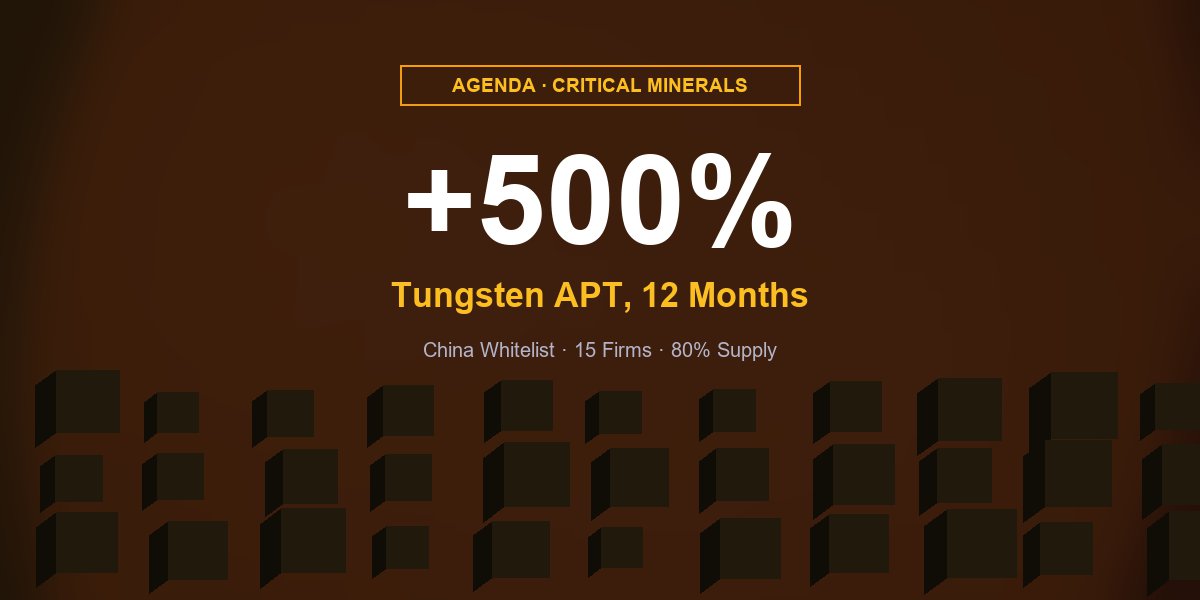
Ammonium paratungstate (APT) — the proxy benchmark for global tungsten supply — broke from a long-term $300/ton average in early 2025 to roughly $1,775/ton by Q1 2026, a 12-month move of approximately +500%. Tungsten powder spot prices in China crossed 2,000 RMB/kg, up roughly +450% over 14 months. On its Q2 fiscal 2026 earnings call, Kennametal called it an "unprecedented 190% year-over-year tungsten price spike" — the same rally measured against a different reference point, but the same underlying fact.
The trigger was structural. China — which controls roughly 80% of global tungsten supply — issued its 2026 Catalogue of Dual-Use Items and Technologies on December 31, 2025, effective January 1, 2026. Tungsten oxide, tungsten carbide, and APT are all included in the controlled list. More importantly, on December 26, 2025, the MOFCOM published the 2026–2027 export whitelist: only 15 companies are authorized to export tungsten, and unlike rare earths (case-by-case licensing), this operates as a fixed-exporter system where Beijing chooses the firms first and manages volumes after. That is not a negotiating posture. That is the new operating regime.
This is the tradeable map. Three categories of beneficiary, five names worth modeling, and the catalyst calendar that defines the next leg.
The tungsten thesis is not a single trade — it splits cleanly into three structural positions. Each has a different risk profile and a different catalyst sensitivity. Mixing them up is the most common mistake we see in coverage.
These are the names that get the full rally on a 1-for-1 basis with APT. Production capacity outside China is the binding constraint, and almost every Western miner with permitted ounces in development is being repriced as a strategic asset.
Why this is the headline name: Sangdong is the only major tungsten mine restart in the West and was the world's largest tungsten producer for decades before closing in the 1990s. Phase 1 commissioning was formally completed in March 2026 — exactly the window where APT printed all-time highs. Almonty's Q1 2026 revenue estimate is CA$31M, ramping to CA$124M by Q4 as Sangdong scales. That is a 4x quarterly revenue trajectory in a single fiscal year, into a price environment that did not exist in any of the company's prior guidance.
Analyst posture: On March 20, 2026, the sell-side reiterated Buy with a price target raised from $14.00 to $19.25 per share — done after the rally, which is the more relevant signal. The 12-month consensus average is ~CA$23.71 with a high estimate of CA$36 and a low of CA$7.50. The dispersion itself tells you the thesis hinges on whether APT holds above $1,500.
Risk: Sangdong execution is no longer the binary — that gate is cleared. The remaining variables are South Korean offtake structure, Phase 2 timing, and whether retail momentum has already pulled forward the trade.
The high-beta microcap tungsten exposure. IMA mine in Idaho is a former producer being readied for restart — there is a domestic-supply premium narrative the market has not yet fully priced. Two characteristics matter for positioning: (a) low free float and small market cap make this a textbook squeeze candidate on any DoD/DLA contract print, (b) OTC listing carries genuine delisting risk and meaningful liquidity gaps. Sizing should match the optionality, not the conviction.
Both genuinely sit on the thesis but require ASX brokerage access. We mention them so the universe is complete, not because they are the actionable trade for a US-based account.
This is where the article-level thesis is more nuanced. Tooling companies use tungsten as a raw input, so a naive read is that input cost compression hits gross margin. The actual data from earnings calls in Q1–Q2 2026 disagrees: integrated players have meaningful pricing power, the vertically owned mines are now revaluation candidates on their own, and the customers (industrial, aerospace, defense) cannot substitute fast enough to push back.
Sandvik is the only Western tooling major that owns its tungsten production end-to-end. Wolfram Bergbau und Hütten in Mittersill, Austria — acquired in 2009 — is the only fully integrated tungsten smelting operation outside Asia and Russia. Mittersill alone produces 25–30% of European tungsten ore. Concentrate moves through Wolfram's smelter to powder, to carbide, to drill bits and cutting tools sold under the Sandvik brand. The acquisition of Buffalo Tungsten in 2025 added US-side recycling and powder capacity. The Wolfram book value inside Sandvik is the most underappreciated asset on this rally.
The first read on Kennametal is "tungsten input cost crushes margin." The data from Q1 and Q2 fiscal 2026 disagrees. Management has already implemented mid-single-digit list price increases effective January 1, 2026, and is guiding to an 11% net price/tariff effect for fiscal 2026 with a 13% impact in fiscal Q3. Net price is passing through the cost pressure — and meaningfully more.
The structural advantage that Kennametal flagged on the call: zero Chinese tungsten dependence, with sourcing diversified across recycling, internal Bolivia operations, and Western suppliers. That is exactly the characteristic the new whitelist regime makes valuable. Jefferies upgraded the name explicitly on the tungsten thesis in early 2026.
Net result: KMT looks more like a clean integrated beneficiary than the "ambivalent margin compression" story the surface read suggests. Lower beta than ALM, but with a real fundamental tailwind that the Street is still re-rating through.
The third bucket is the wider critical-minerals tailwind. These names do not move 1-for-1 with APT, but they do benefit from the same Washington policy posture and the same "non-China supply chain" narrative.
| Ticker | Thesis fit | Liquidity | Risk / reward profile |
|---|---|---|---|
| ALM (NASDAQ) | Pure-play, post-commissioning | Mid-cap, liquid | Primary play — momentum + analyst coverage + cleared execution gate |
| TUNGF (OTCQB) | Microcap squeeze + DoD optionality | OTC, thin | High beta — meaningful delisting and liquidity risk; size accordingly |
| SDVKY (ADR) | Vertically integrated, Wolfram + Buffalo | Large, liquid | Lower beta integrated play; the Mittersill asset is the under-the-radar piece |
| KMT (NYSE) | Tooling with pass-through pricing power | Mid-large, liquid | Cleanest non-China-supply tooling; Jefferies upgrade already on the tape |
| MP / USAR / UUUU | Critical-minerals basket | Liquid | Indirect — same wind, different metal; useful as basket context not lead trade |
The 2026–2027 whitelist locks 15 firms in. Markets keep waiting for "China lifts controls" headlines. The cleaner read of the policy mechanics: tightening (fewer firms, lower volume quotas, expanded product scope) is far more likely than reversal during 2026, because the export controls are being framed in Beijing as a national security tool, not a trade lever. Each MOFCOM update inside this regime is a positive supply-side signal for APT.
The Department of Defense announced an up-to-$1B stockpile materials RFI in 2025; the FY24 NDAA explicitly requires DOD to brief Congress on non-China tungsten feedstocks and a five-year acquisition plan. The Defense Industrial Base Consortium issued a new critical minerals project RFP in March 2026. These are publicly filed events. Every miner on the whitelist of bid-eligible suppliers gets a step-function repricing on contract award.
Almonty's quarterly revenue ramp from CA$31M to CA$124M assumes Sangdong reaches steady-state production by Q4 2026. Any execution slip pushes the supply gap further out and re-tightens APT. Any clean execution proves Western miners can fill demand without permanent price rationing — which is the bear case the bulls are actively testing.
For traders running 8-K filing scanners and small-cap squeeze setups, the tungsten thesis is a clean keyword expansion. Adding the right terms to an existing scanner picks up most of the catalyst flow before headline-driven gaps materialize.
Primary: tungsten, APT, ammonium paratungstate, tungsten carbide, tungsten oxide, scheelite
Policy / contract: strategic minerals, critical minerals, DLA award, DPA Title III, DoD stockpile, Defense Production Act, RFP critical materials, MOFCOM whitelist
Operational: Sangdong commissioning, IMA mine restart, Mittersill, Panasqueira, Wolfram Bergbau, Buffalo Tungsten
Backtest window: 60-day and 180-day windows on 8-K filings containing any combination of the above against small/mid-cap miners (ALM, TUNGF, USAR, UUUU, MP) and integrated tooling (SDVKY, KMT, IR). The asymmetry on contract award filings is the highest-edge signal in the set.
The tungsten rally is not the kind of squeeze that quietly retraces. The supply-side mechanism is now policy, not inventory. China's whitelist locks the structure for at least 18 months; DoD funding is rebuilding non-China stockpiles that have been allowed to atrophy for 30 years; and the only fully integrated Western producer (Sandvik / Wolfram Bergbau) is sitting on an asset whose book value the market has not begun to mark to 2026 APT prices.
The cleanest implementation: ALM as the primary pure-play with cleared execution risk; SDVKY as the integrated lower-beta version of the same trade with the Mittersill asset as a free option; KMT as the pricing-power tooling exposure that is already passing through the cost. TUNGF is optional sizing for catalyst-driven traders comfortable with OTC mechanics. The defense-prime and rare-earths exposures are basket context, not the lead position.
And the catalyst calendar is dense: DLA awards, Sangdong Phase 2, MOFCOM updates, KMT Q3 print, Sandvik Q2 disclosure, NDAA drafting. The thesis prints itself, contract by contract, through 2026.
Real-time XAU sentiment, BTC / Nasdaq / silver scores every 15 minutes, plus critical-minerals contract flags when DLA RFP and 8-K filings hit the tape.
Join ChannelCompanion piece: every major fund deploying into the 2026 AI capex sprint — same "control the bottleneck" thesis pattern that drives the tungsten trade.
Read the Map