
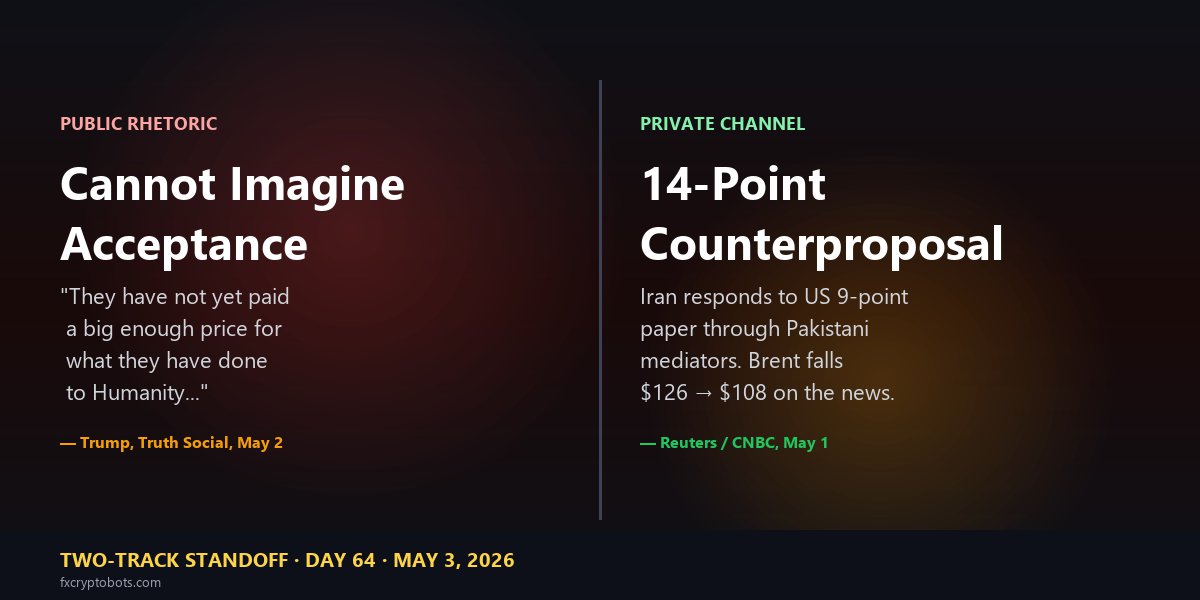
Trump did not soften the rejection. He framed it medically. Standing in front of the press pool Monday before his Tuesday departure for Beijing, the President said the ceasefire he extended indefinitely a fortnight ago is now “on massive life support, where the doctor walks in and says, Sir, your loved one has approximately a 1% chance of living.” He called Iran's counterproposal “simply unacceptable” and “totally unacceptable” within the same minute. Within an hour, the Iranian Foreign Ministry put out a four-word reply: “Iran will never bow.”
The counterproposal itself, leaked through Al Jazeera and confirmed in fragments by Axios, Time, and PBS, had four core demands plus an unusual stipulation on uranium that became the single largest reason for the rejection:
Iran is asking for direct compensation for damage from the air war that began Feb 28, with figures floated in the $250–300B range. The earlier $270B figure was framed as a release of frozen assets plus damages claim; the new version splits the two and treats reparations as separate fresh cash. The administration cannot sell that domestically with the Pentagon hawks in the room.
The text reportedly demands explicit US recognition that Hormuz is Iranian sovereign waters and that any future US naval presence requires Tehran's permission. This is structurally incompatible with how the US Navy has operated in the Gulf since 1949. It is also incompatible with GCC partner expectations — UAE just left OPEC partly over Iranian leverage, and Saudi Arabia will not accept Iran-permitted shipping lanes.
Iran's earlier proposals accepted a phased sanctions schedule. The May counterproposal accelerates this to all sanctions lifted at signing, before any nuclear concessions begin. This is a sequencing flip the State Department had explicitly told Tehran would be rejected.
This is the line nobody saw coming. Iran offered to give up its estimated 440 kg of highly enriched uranium — but only if the United States physically extracts it from the bombed nuclear sites where it now sits, buried under collapsed concrete from the February strikes. Trump publicly noted Monday that Iran did not include a clean transfer clause: “they want us to come and remove it, with the uranium buried under nuclear sites that the US bombed.” That structurally locks the US into either acknowledging the bombed sites contain extractable HEU — an admission with non-proliferation implications — or rejecting the offer outright. Trump chose the second.
What changed: the May 3 narrative was “two-track standoff, Pakistan channel still open, Saturday closure passed without a kinetic spark, Brent printing $108 with $126 high already faded.” The May 11 narrative is “counterproposal rejected on the record, Iran says it will never bow, the burial clause cannot be unwound in twenty-four hours, the Pentagon camp inside the White House is now writing strike packages openly, and Trump leaves for Beijing tomorrow with the Iran file as the dominant agenda item.” The grind trade did not break gradually. It broke in one Monday afternoon press availability.
Reuters, Time, and Politico have all confirmed in the past 72 hours that there are now two formal camps inside the administration arguing for alternating paths. The Monday rejection did not pick a winner — it ended the ambiguity that let the diplomacy track keep oxygen.
Argues a more aggressive posture is the only way to pressure Tehran to a deal Washington can sell domestically.
Argues another window is achievable through Beijing — Xi has direct leverage and the Tuesday meeting is structurally an off-ramp.
Why traders should care about the camp split: for two months the camps cancelled each other and the market priced “frozen but functional.” The Monday rejection broke that equilibrium. The Pentagon camp now has a writable rationale for a phased strike option — not a war declaration, but a Tomahawk-class signal against IRGC fast-attack craft or a command-and-control node that Iran cannot publicly absorb without retaliating. That is a new trajectory the market did not have to price five days ago. The Xi meeting is the only thing standing between the camp split and the strike option getting written into a finished package this week.
A week ago we ranked Trajectory A (frozen blockade grind) at 36%, Trajectory C (kinetic spark from Iran) at 28%, Trajectory B (Pakistan-mediated climbdown) at 22%, and Trajectory D (open conflict) at 14%. The Monday rejection forces a new path onto the board: Trajectory E — phased Pentagon strikes, distinct from open conflict because it is unilateral, calibrated, and tied to a deal-reset goal rather than regime change. We split the probability mass.
Inside three weeks, the US conducts a calibrated strike package against IRGC fast-attack craft, naval mining infrastructure, or a single C2 node. The objective is signalling, not regime change — phase one of a multi-step ladder. Iran responds with a constrained retaliation that does not target US personnel directly: a tanker swarm, a stand-off missile demonstration into Omani waters, a soft cyber incursion. Both sides return to the table within six weeks at a worse equilibrium for Iran.
Despite the rejection, both sides quietly hold position. Hormuz transit stays at single digits but no incident escalates. The Xi meeting produces enough atmospheric language to keep diplomacy alive without resolving the burial clause. The market accepts that “1%” is rhetoric, not a deadline. Brent reverts to the $98–108 range, gold ranges $4,600–4,800, BTC chops $76K–84K.
Iran chooses to translate “never bow” into action before the Pentagon camp writes its package. IRGC swarm against a US-flagged escort, mining of the central channel, missile demonstration into Omani or Saudi waters. The administration's strike option is then reactive rather than initiating — same market impact, different optics.
The Tuesday Beijing meeting produces a face-saving reframe. Xi delivers Tehran a sequencing concession; Trump claims a win on the burial clause by accepting an IAEA-verified sealed-site extraction. The crypto-toll proposal returns to the agenda. Project Freedom resumes; Iran formally drops the “never bow” framing in a follow-up statement.
The phased Pentagon strike misfires or Iran's retaliation kills US personnel. Hormuz closure becomes complete and indefinite. A regional power (Israel, Saudi Arabia) is directly drawn in. The conflict expands beyond the 75-day boundaries.
What just changed: the Monday rejection put a second engine under gold again. The Warsh cap at $4,800 is being tested for the first time in eight sessions. The Pentagon phase rationale gives the cap a path to break that has nothing to do with the Fed reaction function.
Setup: buy washouts $4,640–4,680 with stop $4,580. A confirmed Trajectory E entry on Eisenhower repositioning is a buy-into-strength setup, not a fade.
What just changed: less than gold. Tether supply is still pushing $150B. The May 11 reaction was orderly — BTC absorbed the rejection without losing $80K. The kinetic-spark flush risk to $72K is still live, but only on Trajectory C or D.
Setup: $80K is the line. Hold it through the Xi meeting and $86K opens. Lose $77K and the macro narrative resets independent of Iran.
Read the May 11 divergence carefully: on a Pentagon-led kinetic phase, gold goes first and Bitcoin lags down before recovering on DXY softness. On an Iran-initiated spark, both flush briefly but Bitcoin recovers faster. On a Xi-mediated climbdown, Bitcoin goes first and gold lags down hard. On a continued frozen grind, both chop within their two-week ranges. Position around which trajectory you are paying for — the divergence itself is still the highest-conviction expression on the screen.
| Asset | Pentagon Phase (E) | Iran Spark (C) | Xi Climbdown (B) | Frozen Grind (A) |
|---|---|---|---|---|
| Gold (XAUUSD) | Buy $4,640–4,680, target $4,950 then $5,100; stop $4,580. | Buy first 2% fade after gap; target $5,000 then $5,150. | Sell $4,720, target $4,500 then $4,420. | Range $4,600–4,800; buy washouts, sell rallies. |
| Bitcoin (BTCUSD) | Buy first flush to $74K–76K; target $86K+ in two weeks. | Buy flush to $68K–72K; target $84K once DXY softens. | Long $80K, target $86K then $90K; stop $77K. | Range $76K–84K; correlation trade vs Nasdaq. |
| Brent Oil | Buy first 4% fade post-strike; $118 then $128. Outright over calendar. | Buy first 5% fade; $122 then $130 on sub-5 transit. | Short $104, target $94 first, $86 on confirmation. | Range $98–108; structural premium intact. |
| DXY | Spike on Treasury bid, fades within ten sessions. | Initial spike, fades faster as Fed reprices. | Softens on de-risking; EUR/USD long is cleaner. | Mildly bid; range-bound. |
| VIX | 32–44 print on first strike; put spreads. | 32–40 on first incident headline. | 12–15; sell premium on relief. | 17–22 range; cheap optionality. |
| Defense / shipping | Gap up 5–9%; RTX, LMT, NOC, ZIM, Kongsberg lead. | Gap up 4–7%; stay positioned through volatility. | Underperform; rotate into refiners and airlines. | Quiet outperformance on insurance repricing. |
What to watch over the Beijing window: (1) Eisenhower carrier group movement — Pentagon confirmation is the Trajectory E tell. (2) The Xi-Trump joint readout language — “framework” or “technical” keeps B alive; silence on Iran or any “cannot accept” framing tips the board toward E. (3) Iranian state TV repeating “never bow” with named officials — raises the public floor and accelerates E. (4) Project Freedom resumption with broader scope — intermediate signal between A and E. (5) Lloyd's war-risk curve shape and Aramco follow-up — the curve tells you which trajectory the physical market is paying for. (6) The 440 kg HEU storyline — any IAEA leak about verifiable extraction conditions would be the Trajectory B unlock.
XAU Sentinel posts scored market-sentiment updates every 15 minutes to our free Telegram channel. Eisenhower repositioning watch, Hormuz transit count, Xi readout language tracking, Aramco supply numbers — one feed, no card, no signup.
Join the Telegram channel →Our Data Releases Explorer shows you exactly how NFP, CPI, FOMC, and 7 other US economic events have moved XAUUSD across 18 years — with interactive charts and 200+ data points. Free to use, no signup, into May's CPI catalyst alongside the Iran tape.
Open the Data Releases Explorer →Disclaimer: This is analysis, not trade advice. Geopolitical windows invalidate fast and the Beijing readout could rewrite the trajectory mass inside one news cycle in either direction. Size your positions for the trajectory you can actually be wrong on, not the one you want to play out. The Pentagon phase and the Xi-mediated climbdown are not symmetric — one is a tail with binary outcomes, the other is a relief rally with a clean stop. Treat them differently.